
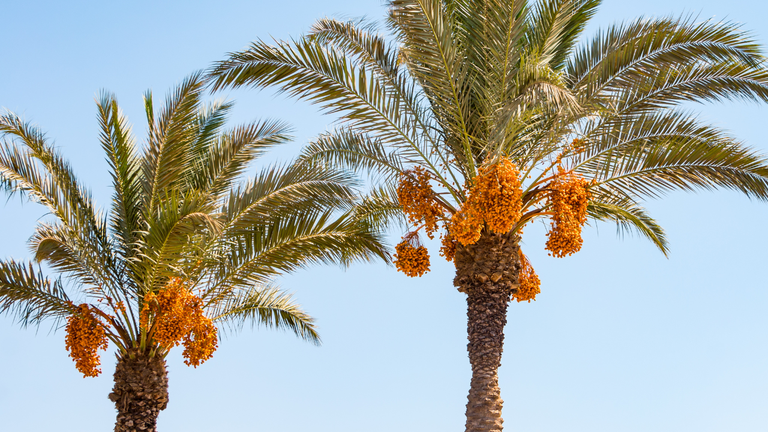
In this blog, we tell you more about where dates come from. Dates grow in the wild in various countries around the world. Below, we share more about the countries of origin, what dates actually are, and which varieties are currently popular.
What is a date?
The date is classified as a stone fruit. A fruit falls into this category if it has a hard pit at its core. In addition to dates, this group includes fruits such as cherries, peaches, nectarines, plums, and apricots. Dates grow on date palms. These palms are found only in the warmer regions of the planet.
How healthy are fresh dates?
What makes fresh dates so healthy? First of all, dates are packed with fiber. This is not only beneficial for your gut flora, but their satiating effect also helps you feel full sooner. Additionally, the fruit contains various vitamins, such as vitamins A, B, C, E, and K. There is also no shortage of antioxidants. Finally, dates are a source of minerals; most varieties contain minerals such as calcium, potassium, magnesium, iron, and zinc.
The origins of dates
Date cultivation originated in the Middle East. We do not know exactly when it began, but we do know that dates have been eaten since 3,000 BC. Today, most dates come from the Middle East and North African countries. Egypt is currently the world’s largest producer. Other countries that export large quantities of dates include Iran, Saudi Arabia, the United Arab Emirates, Pakistan and Algeria.
What varieties of dates are there?
It is estimated that there are more than 1,500 varieties of dates worldwide. The environment in which they grow has a significant impact; for instance, the soil can influence the nutrient content of the date. Furthermore, dates can differ in various respects, such as size, taste, texture (softness), nutritional profile, and processing methods. Below, we tell you more about some of the most popular date varieties available today.
Medjoul dates
The Medjoul is currently one of the bestselling date varieties. These dates come from the Middle East and stand out because of their size. A Medjoul date can grow up to an impressive 7 cm long. This size makes Medjoul dates slightly more expensive than other varieties. The Medjoul is among the most nutritious date varieties available today, containing minerals such as potassium, calcium, phosphorus, magnesium and iron.
Deglet Nour
The Deglet Nour is also among today’s most widely imported date varieties. Deglet Nour dates are less expensive than Medjoul dates, but they are also considerably smaller. They have a less sweet flavour than other varieties and are almost always sold dried. Most Deglet Nour dates come from Tunisia and Algeria.
Dalia Sukkary
Our personal favorite is the Dalia Sukkary. It is no coincidence that Yogi & Yousef chooses this particular date variety. For starters, it offers the most delicious flavor; it is pleasantly sweet with a caramel-like taste. This variety is also packed with vitamins, minerals, and fiber. We do not process our dates. This ensures not only that they are wonderfully fresh but also that they retain their natural nutrients to the fullest. Furthermore, no additives—such as sugars or preservatives—are added.
Where do our dates come from?
Our Dalia Sukkary dates come from Saudi Arabia. To ensure they remain as healthy and delicious as possible, they are produced using the most natural methods available, with a strong focus on sustainability. Thanks to the fertile soil in which they grow, Dalia Sukkary dates contain certain minerals not found in other date varieties—such as copper and manganese.